
ACS General Chemistry Exam Study Guide PDF: A Comprehensive Plan
Preparing for the ACS General Chemistry exam requires a focused study plan. The official study guide, available on Amazon, is a crucial resource.
It provides practice questions and insights into the exam’s structure, aiding comprehensive preparation.
Understanding the ACS Exam
The American Chemical Society (ACS) General Chemistry exam is a standardized test widely used by colleges and universities to assess a student’s understanding of general chemistry principles. It’s crucial for students aiming for advanced coursework or research opportunities. The exam isn’t a simple recall of facts; it emphasizes problem-solving and critical thinking skills.
Understanding the exam’s purpose is the first step in effective preparation. The ACS exam evaluates a student’s ability to apply chemical concepts to new situations, rather than just memorizing definitions. The official ACS study guide, found on platforms like Amazon, is designed to mirror the exam’s style and difficulty.
This guide provides valuable insights into the types of questions asked and the reasoning behind the correct answers. Familiarizing yourself with the exam format – multiple-choice questions requiring calculations and conceptual understanding – is paramount. Recognizing the exam’s focus on application, not just memorization, will shape your study approach and maximize your performance.
Exam Format and Sections
The ACS General Chemistry exam consists of approximately 60 multiple-choice questions, delivered in a single session. These questions are designed to assess your understanding across several core chemistry topics. The exam’s structure is intentionally broad, covering fundamental principles and their applications. The official ACS study guide, available through resources like Amazon, meticulously replicates this format.
Sections typically include atomic structure, chemical bonding, stoichiometry, states of matter, and chemical kinetics. A significant portion focuses on quantitative problem-solving, requiring calculations and unit conversions. Conceptual questions testing your understanding of underlying principles are also prevalent.
The exam is divided into sections, but these aren’t explicitly labeled during the test. Instead, questions are presented in a mixed order, demanding a comprehensive grasp of all areas. Utilizing the practice exams within the official study guide is vital to becoming comfortable with this integrated format and pacing yourself effectively throughout the exam.
Scoring and Percentiles
The ACS General Chemistry exam is scored based on the number of correctly answered multiple-choice questions. There is no penalty for incorrect answers, so attempting every question is highly recommended. Your raw score is then converted to a percentile rank, allowing you to compare your performance to other test-takers.
Understanding these percentiles is crucial for evaluating your readiness and identifying areas for improvement. The official ACS study guide provides valuable insights into score distributions and expected performance levels. It doesn’t explicitly state passing/failing scores, as requirements vary depending on the institution utilizing the exam.
Generally, a higher percentile rank indicates a stronger grasp of the material. Aiming for the 75th percentile or above demonstrates a solid understanding of general chemistry principles. Consistent practice with the questions in the official guide, available on platforms like Amazon, will help you gauge your progress and refine your test-taking strategies to maximize your score and percentile rank.
Essential General Chemistry Topics
The ACS General Chemistry exam comprehensively assesses your understanding of fundamental chemistry principles. Mastery of several core areas is vital for success. These include atomic structure and periodic trends, understanding electron configurations and periodic properties. Chemical bonding and molecular structure, including Lewis structures and VSEPR theory, are also critical.
Furthermore, a strong foundation in stoichiometry and chemical reactions, including balancing equations and calculating yields, is essential. Don’t overlook states of matter and gas laws, as well as solutions and solubility concepts. A solid grasp of acids and bases, including pH calculations and titrations, is also necessary.
The exam also covers chemical kinetics, chemical equilibrium, thermodynamics, electrochemistry, and even introductory organic chemistry. Utilizing the official ACS study guide, found on resources like Amazon, will help you prioritize these topics and focus your preparation effectively.

Atomic Structure and Periodic Trends

A firm grasp of atomic structure is foundational for the ACS General Chemistry exam. This includes understanding the components of an atom – protons, neutrons, and electrons – and their respective charges and masses. You’ll need to be proficient in determining atomic number, mass number, and isotopic composition.
Periodic trends are equally important. Mastering how properties like ionization energy, electronegativity, atomic radius, and metallic character vary across periods and down groups is crucial. Be prepared to explain these trends based on effective nuclear charge and shielding effects.
Electron configurations, utilizing the Aufbau principle, Hund’s rule, and Pauli exclusion principle, are frequently tested. Understanding orbital diagrams and quantum numbers is also vital. The official ACS exam preparation materials, like the guide available on Amazon, will provide practice problems to solidify your understanding of these core concepts. Focus on relating structure to periodic behavior.
Chemical Bonding and Molecular Structure

Chemical bonding is a cornerstone of general chemistry, and the ACS exam heavily emphasizes this topic. You must understand the differences between ionic, covalent, and metallic bonds, and be able to predict bond types based on electronegativity differences. Lewis structures are essential; practice drawing them accurately, including resonance structures when applicable.
Molecular structure builds upon bonding. VSEPR theory is critical for predicting molecular geometries – linear, trigonal planar, tetrahedral, etc. – and understanding how these shapes influence polarity. Be prepared to determine bond angles and identify polar versus nonpolar bonds and molecules.
Hybridization of atomic orbitals (sp, sp2, sp3) and its relation to molecular geometry are frequently assessed. The official ACS study guide, found on platforms like Amazon, offers targeted practice to strengthen your skills in visualizing and predicting molecular structures. Mastering these concepts is key to success.
Stoichiometry and Chemical Reactions

Stoichiometry forms the quantitative heart of chemistry, and the ACS exam tests your ability to perform calculations involving chemical reactions. Mastering mole concepts, molar mass determination, and balancing chemical equations is paramount. Expect problems requiring you to calculate reactant and product amounts, limiting reactants, and percent yield.
Understanding different types of chemical reactions – precipitation, acid-base, redox – is also crucial. Be able to predict products and write balanced net ionic equations. Redox reactions require proficiency in assigning oxidation numbers and balancing using the half-reaction method.
The official ACS study guide, available through resources like Amazon, provides extensive practice problems covering these concepts. Utilizing this guide will help you develop a strong foundation in stoichiometric calculations and reaction prediction, essential for achieving a high score on the exam. Don’t underestimate the importance of dimensional analysis!
States of Matter and Gas Laws
The ACS General Chemistry exam heavily emphasizes understanding the behavior of matter in its various states – solid, liquid, and gas. You’ll need to grasp intermolecular forces and how they influence physical properties like boiling point and vapor pressure. Expect questions involving phase changes and energy calculations (heating/cooling curves).
Gas laws are fundamental. Mastery of Boyle’s, Charles’s, Avogadro’s, and the Ideal Gas Law (PV=nRT) is essential. Be prepared to apply these laws to solve problems involving gas volume, pressure, temperature, and moles. Understanding deviations from ideal gas behavior, particularly at high pressures and low temperatures, is also important.

The official ACS study guide, accessible through platforms like Amazon, offers targeted practice problems in this area. Working through these examples will solidify your understanding of state functions and gas law applications, significantly boosting your exam performance. Remember to pay attention to unit conversions!
Solutions and Solubility
The ACS General Chemistry exam tests your knowledge of solution chemistry, focusing on concepts like solubility, concentration units, and colligative properties. You must understand the factors affecting solubility – temperature, pressure (for gases), and the nature of the solute and solvent. Be prepared to calculate molarity, molality, and percent composition.
Colligative properties – boiling point elevation, freezing point depression, osmotic pressure, and vapor pressure lowering – are frequently assessed. You’ll need to apply these concepts to determine unknown molar masses or solution concentrations. Understanding the impact of electrolytes on colligative properties is crucial; remember to account for the van’t Hoff factor.
The official ACS exam preparation materials, found on resources like Amazon, provide practice problems specifically designed to reinforce these concepts. Utilizing these resources, alongside a thorough review of solubility rules and solution stoichiometry, will greatly enhance your preparedness for this section of the exam.
Acids and Bases
A strong understanding of acid-base chemistry is vital for the ACS General Chemistry exam. Expect questions covering definitions of acids and bases (Arrhenius, Bronsted-Lowry, Lewis), pH calculations, and strong vs. weak acid/base behavior. Mastering the pH scale and its relationship to [H+] and [OH-] is essential.
Titration calculations, including equivalence points and indicators, are frequently tested. Be prepared to work with buffer solutions, understanding their composition and how they resist pH changes. The Henderson-Hasselbalch equation is a key tool for buffer calculations.
The official ACS study guide, available through resources like Amazon, offers targeted practice problems to solidify your understanding of these concepts. Focus on mastering acid dissociation constants (Ka) and base dissociation constants (Kb), and their application in determining solution acidity or basicity. Reviewing polyprotic acids and their stepwise dissociation is also recommended.
Chemical Kinetics
Chemical kinetics, the study of reaction rates, is a significant component of the ACS General Chemistry exam. Expect questions focusing on rate laws, reaction orders, and the factors influencing reaction rates – concentration, temperature, and catalysts.
Understanding the integrated rate laws for zero-order, first-order, and second-order reactions is crucial. Be prepared to determine rate constants and predict reaction times using these laws. The Arrhenius equation, relating rate constant to temperature and activation energy, is also frequently tested.
The official ACS study guide, accessible through platforms like Amazon, provides practice problems to reinforce these concepts. Focus on interpreting experimental data to determine rate laws and activation energies. Collision theory and the concept of activated complexes are important foundational ideas. Review reaction mechanisms and how they relate to the overall rate law; identifying rate-determining steps is key.
Chemical Equilibrium
Chemical equilibrium is a core concept on the ACS General Chemistry exam, demanding a thorough understanding of reversible reactions and the factors affecting equilibrium. Expect questions involving the equilibrium constant, K, and its relationship to reaction quotient, Q.
Master Le Chatelier’s principle, predicting how changes in concentration, temperature, and pressure (for gaseous systems) shift equilibrium. Calculating equilibrium concentrations using ICE tables (Initial, Change, Equilibrium) is a vital skill. Be prepared to apply these principles to both homogeneous and heterogeneous equilibria.
The official ACS study guide, found on resources like Amazon, offers practice problems to solidify your grasp of these concepts. Pay attention to the relationship between K and ΔG (Gibbs free energy change). Understanding the significance of K values – indicating the extent of reaction completion – is essential. Practice applying these concepts to real-world scenarios and complex reaction systems.
Thermodynamics
Thermodynamics is a significant section on the ACS General Chemistry exam, focusing on energy changes in chemical and physical processes. A strong grasp of concepts like enthalpy (H), entropy (S), and Gibbs free energy (G) is crucial. Expect questions involving Hess’s Law for calculating enthalpy changes and understanding the spontaneity of reactions.
Be proficient in applying the first and second laws of thermodynamics. Understand how entropy relates to disorder and the implications for reaction favorability. Calculating ΔG from ΔH and ΔS is a key skill. The official ACS study guide, available through resources like Amazon, provides practice problems to reinforce these concepts.
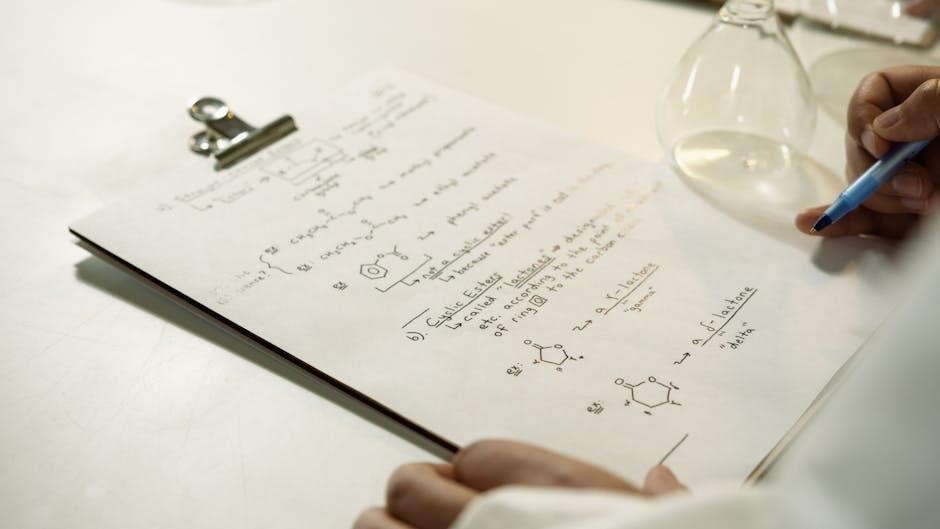
Pay close attention to state functions and their properties. Practice applying thermodynamic principles to various processes, including phase transitions and solution formation. Mastering these concepts will significantly improve your performance on the exam.
Electrochemistry
Electrochemistry is a core component of the ACS General Chemistry exam, demanding a solid understanding of redox reactions and their applications. Expect questions on electrochemical cells, including galvanic (voltaic) and electrolytic cells. Familiarize yourself with concepts like cell potential (E°cell), standard reduction potentials, and the Nernst equation.
Balancing redox reactions in both acidic and basic conditions is essential. Understand how to identify oxidizing and reducing agents. The official ACS study guide, accessible through platforms like Amazon, offers practice problems to hone these skills. Be prepared to calculate cell potential under non-standard conditions using the Nernst equation.
Electrolysis and its applications, such as quantitative electrolysis, are also frequently tested. Grasp the relationship between current, charge, and the amount of substance produced. Mastering these concepts will be vital for success on the exam.
Nuclear Chemistry
Nuclear chemistry represents a significant portion of the ACS General Chemistry exam, requiring a grasp of radioactive decay and nuclear reactions. You’ll need to understand alpha, beta, and gamma decay, including their effects on nuclear composition. Be prepared to balance nuclear equations and predict decay products.
Half-life calculations are crucial; mastering this concept is essential for solving related problems. The official ACS study guide, found on resources like Amazon, provides practice questions specifically designed to test your understanding of radioactive decay rates. Expect questions involving carbon-14 dating and other radiometric dating techniques.
Nuclear fission and fusion, along with their energy implications (E=mc²), are also frequently assessed. Understand the differences between these processes and their applications. A thorough review of these topics, utilizing the official guide, will significantly improve your performance on the exam.
Organic Chemistry Fundamentals
The ACS General Chemistry exam includes a foundational section on organic chemistry, testing your understanding of basic functional groups and nomenclature. Familiarize yourself with alkanes, alkenes, alkynes, alcohols, ethers, aldehydes, ketones, carboxylic acids, and amines – recognizing their structures and properties is key.
Isomerism, including structural and geometric isomers, is a frequently tested concept. Practice drawing and naming organic compounds, and be prepared to identify different types of isomers. The official ACS study guide, available through resources like Amazon, offers targeted practice problems to hone these skills.
Basic reaction mechanisms, such as addition and substitution, may also be included. Understanding the concept of hybridization (sp3, sp2, sp) and its relation to molecular geometry is also important. A solid grasp of these fundamentals, reinforced by the official study materials, will boost your confidence and score.
Laboratory Skills and Safety

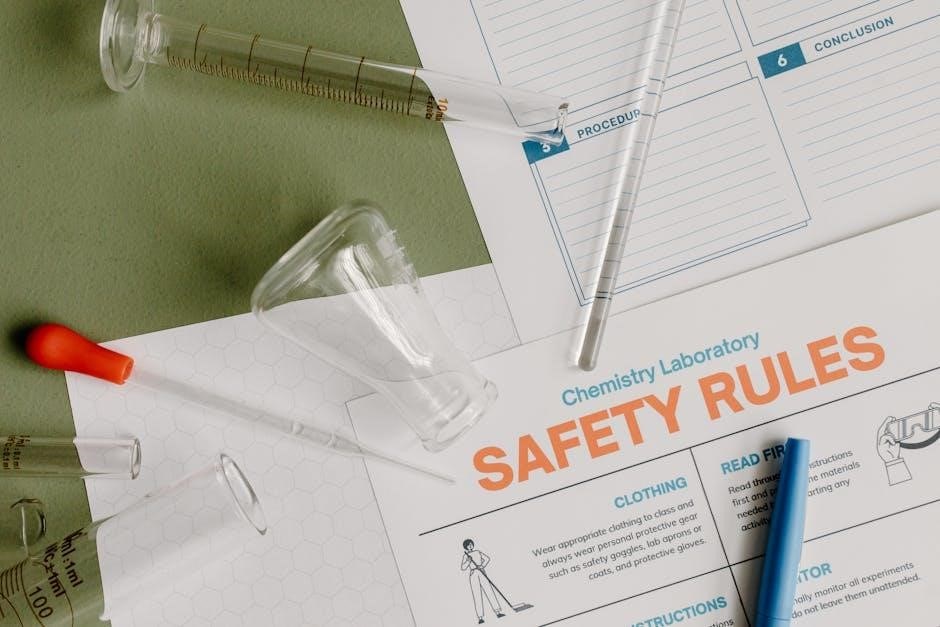
A significant portion of the ACS General Chemistry exam assesses your understanding of laboratory procedures and safety protocols. Expect questions relating to proper technique, data analysis, and error identification within experimental settings.
You should be comfortable with common lab equipment – burets, pipettes, spectrophotometers – and their appropriate uses. Understanding significant figures, precision, and accuracy in measurements is crucial. The exam often presents scenarios requiring you to interpret experimental data and draw valid conclusions.
Safety is paramount. Be prepared to answer questions about handling chemicals, waste disposal, and emergency procedures. The official ACS study guide, accessible through platforms like Amazon, dedicates sections to these vital aspects. Reviewing these materials thoroughly will ensure you’re well-prepared to demonstrate safe and competent laboratory practices on the exam.
Utilizing the Official ACS Study Guide
The “Preparing for Your ACS Examination in General Chemistry” guide, available on Amazon, is the cornerstone of effective exam preparation. This official resource, published by the American Chemical Society Division of Chemical Education Examinations Institute, directly reflects the exam’s content and format.
Focus on the practice questions. These aren’t just for assessment; they’re learning tools. Analyze both correct and incorrect answers to understand the underlying concepts and reasoning. Pay close attention to the detailed explanations provided for each question.
Utilize the guide’s breakdown of topics. It highlights areas of emphasis, allowing you to prioritize your study efforts. Supplement the guide with other resources, but always return to it as your primary reference. The guide’s structure mirrors the exam, fostering familiarity and confidence. Mastering its content significantly increases your chances of success.
Free and Paid Resources for Exam Prep
Beyond the official ACS study guide (available on Amazon), a wealth of resources exists to bolster your preparation. Numerous free online platforms offer practice problems and concept reviews, such as Khan Academy and MIT OpenCourseware, providing accessible learning materials.
Paid resources often offer more structured and comprehensive support. These include online courses from platforms like Coursera and Udemy, specifically tailored for the ACS exam. Consider investing in supplemental workbooks focusing on challenging topics.
Kindle Unlimited offers access to a vast digital library, potentially including relevant chemistry texts. However, prioritize resources directly aligned with the ACS exam’s content. Remember to critically evaluate the quality and relevance of any resource before incorporating it into your study plan. A blended approach – utilizing both free and paid materials – can maximize your learning efficiency and exam performance.